


Within our written language, we often teach six syllable types as a helpful way to understand how vowel sounds typically behave in English spelling patterns. At the single-syllable level, these patterns are especially useful and often quite reliable.
But as soon as students begin working with longer, multisyllabic words, something else starts to happen.
They apply what they know about sound-spelling patterns, but the word just doesn’t sound right.
“Sometimes—often—that’s because of a tricky little sound called the schwa.”
What Is the Schwa Sound?
The schwa (/ə/) is the most common sound in spoken English. It is a relaxed, neutral vowel sound—often described as a soft “uh”—that is produced with very little effort. You might think of it as a relaxed vowel—a vowel that’s just a little more “chill.”
Unlike other vowel sounds, the schwa is not tied to a specific letter. In fact, any vowel—a, e, i, o, or u—can represent the schwa sound.
Yes—one sound, five possible spellings.
What determines whether a vowel is pronounced as schwa is not the spelling, but the stress pattern of the word.
pen / cil → /ə/
so / fa → /ə/
Understanding this helps explain why students can decode a word correctly and still not recognize it. For instance, a student can decode the word pencil, and come up with: “pen-SIL.”
The issue is not the decoding. It’s that when stressed on the second syllable, and pronounced with a short i sound, the brain may have a hard time recognizing it as a known word.
Why Does English Have so Many Schwa Sounds?
Well, English is a stress-timed language, which means we do not give equal weight to every syllable. Instead, one syllable is emphasized—pronounced more clearly, more fully—while the others are reduced.
Without this pattern of stress and reduction, English would sound unnatural, almost robotic. In contrast, languages like Spanish and French are more syllable-timed, meaning each syllable is pronounced with more even emphasis.
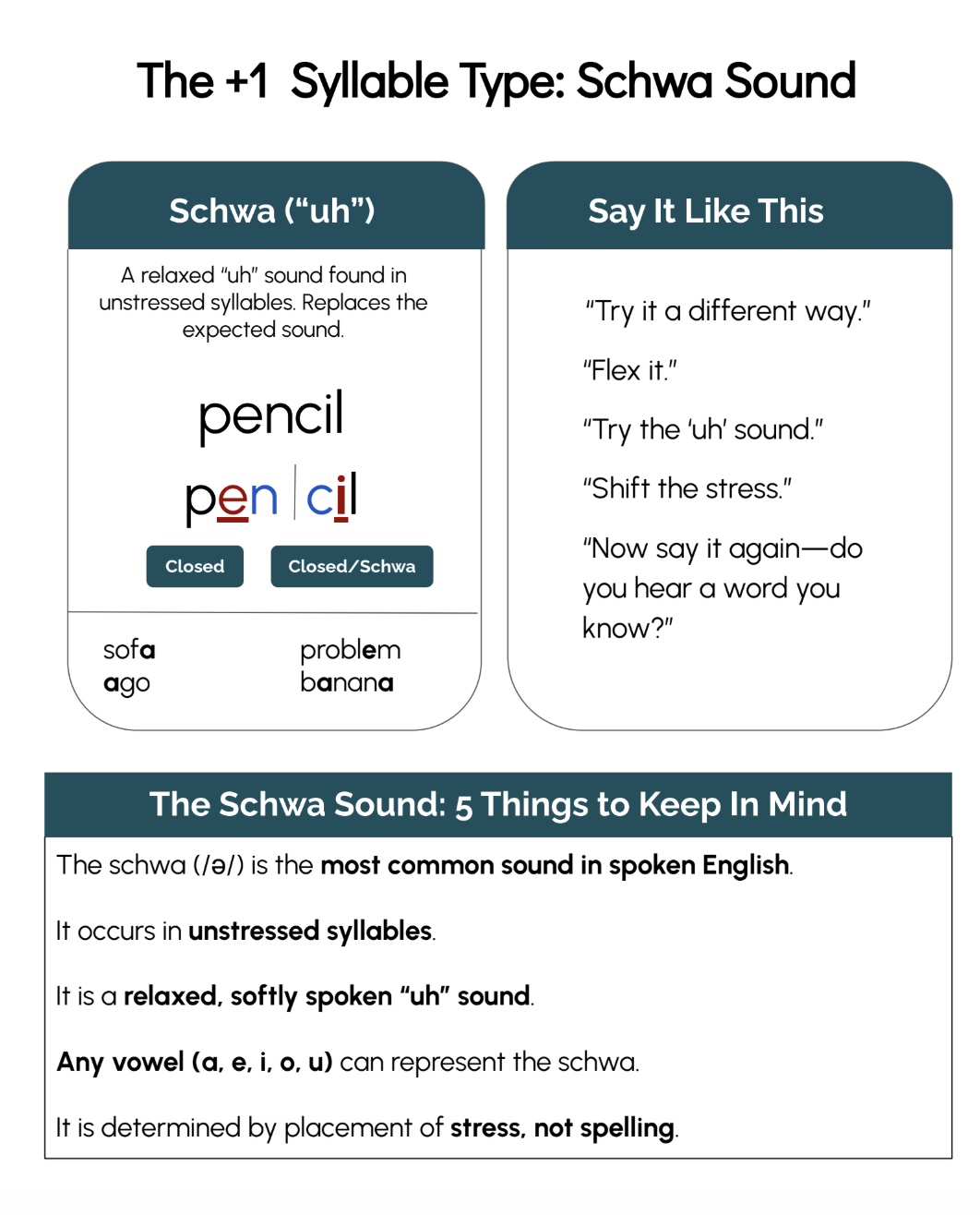
In English, when decoding a word that has more than one syllable, a decision has to be made: Which syllable will carry the stress—and which will relax? The stressed syllable is pronounced with clear emphasis. The unstressed syllable steps back—and that’s often where the schwa appears.
The Schwa Sound as the “+1” Syllable Type
The six syllable types give us a helpful framework for understanding how vowels often behave in English spelling patterns. The schwa helps explain why those patterns don’t always sound the way we expect in multisyllabic words.
The schwa sound is not typically listed as a syllable type, but it appears so frequently—and affects pronunciation so significantly—that it’s worth thinking of it as the “+1.” It connects: spelling patterns, syllable stress, and natural pronunciation.
A Simple Instructional Move for Schwa: Flex the Sound
Students may decode a word accurately based on spelling patterns:
ba / con → “ba-CON”
fun / nel → “fun-NEL”
But the word still doesn’t sound right. At this point, students need extra tools that go beyond basic decoding.
When a word doesn’t sound right, many teachers already prompt students to flex the vowel sound—trying long and short options to see what fits. The schwa simply broadens what it means to flex, so you might expand your prompts accordingly.
Prompts for Schwa Flexibility:
- “Try that again and flex the vowel—this time, try the ‘uh’ sound.”
- “That part might be unstressed. Try relaxing that vowel.”
- “Try saying it with the stress on a different syllable.”
Now, students are not just trying long and short vowel sounds. They are also trying a relaxed /ə/ sound and experimenting with stress. Over time, they begin to expect that not every vowel will say its full sound—and they become more flexible, efficient readers.

Kari’s Tips
Teacher Talk: Teaching Students to Flex the Sound
“You tried that word, and it didn’t quite sound right. Let’s flex the sound. Try it again—this time, relax the vowel in that syllable. It might be an ‘uh’ sound. Now try shifting the stress. Which part sounds strongest? Say it again—does it sound like a word you know?”
Reminder Prompts
Clarity for the Classroom
If syllable types give students a starting point, the schwa helps them make the word sound like real language. The schwa is the most common sound in English, so as soon as students start reading multisyllabic words, they’ll encounter it. When we help them understand and recognize it, we give them a tool for making words sound right.
Download Free Schwa Resources
Reference tools and word lists to help students notice and practice this common pattern.
