
3rd, 4th, and 5th Grade Spelling Word Lists that Build Meaning and Connections
Search for “3rd grade spelling lists,” “4th grade spelling lists,” or “5th grade spelling lists,” and you’ll likely feel overwhelmed by the page after page after page of possibilities.
But they’re all over the map.
Some include 10 words. Others include 25.
Some focus on phonics patterns. Other lists group words by theme.
Most imply a traditional routine:
Study on Monday.
Test on Friday.
Repeat.
But if traditional spelling lists worked as well as we hope, we’d see the transfer to everyday writing, to reading, and even to comprehension.
So why don’t spelling patterns always stick?
It’s not because students aren’t trying.
And it’s certainly not because teachers are working hard.
It’s because isolated word lists ask the brain to store disconnected information.
And the brain prefers networks.
Spelling Word Lists for Grades 3, 4, and 5
If you’re searching for 3rd grade spelling lists, 4th grade spelling lists, or 5th grade spelling lists, you’re likely looking for words your students can learn, remember, and use.
You want more than a list for the week. You want an approach that helps those words stick—beyond Friday’s test and into everyday reading and writing.
That’s where many traditional spelling word lists fall short. When words are grouped without connection, students may memorize them temporarily, but they don’t always retain or transfer what they’ve learned.
When spelling word lists are organized around meaningful parts, something shifts. Students begin to see patterns, recognize connections, and understand how words are built.
They’re not just preparing for a test.
They’re learning how spelling works.
Why Traditional Spelling Lists for Grade 3 – 5 Often Don’t Stick
If traditional spelling lists worked as well as we hope, we would see stronger transfer to everyday writing, reading, and comprehension.
But many students can study a list, pass a test, and still struggle to recognize or spell those same words later.
That’s because long-term word learning depends on an in-the-brain process called orthographic mapping—the process that allows words to be stored for instant retrieval.
And that process depends on three essential elements:
- hearing the sounds in the word
- knowing the spellings that represent those sounds
- understanding the meaning of the word
And while lots of attention has been focused on the first two in recent years, meaning is often the missing leg of the stool.
When spelling lists are studied in isolation, students may remember them long enough for a quiz. But long-term storage requires connections. Words that share structure and meaning are far more likely to stick.
What Are Generative Spelling Lists?
The word generative itself is built from meaningful parts:
The Latin base gen means “to bring forth” or “produce.”
The suffix -ive signals “having the quality of.”
Generative literally means “having the power to produce.”
A generative spelling list does exactly that. It produces networks of related words. It gives students access to far more than the words printed on this week’s spelling list.
A generative spelling list is still a list.
But it is organized around shared morphemes — meaningful parts of words.
Instead of a disconnected collection of words or spellings, students explore networks like:
| Word | Word Sum | Meaning (built from “do”) |
|---|---|---|
| act | act | do |
| action | act + ion | the act of doing |
| active | act + ive | doing; engaged in doing |
| react | re + act | do again; act in response |
| reaction | re + act + ion | the act of responding |
| inactive | in + act + ive | not doing; not active |
Now students aren’t memorizing unrelated items.
They’re building a network.
Generative spelling lists allow students to see that spelling patterns preserve meaning, even if pronunciation changes. Word spellings are not arbitrary. They are constructed from meaningful parts.
Morphology-Based Spelling Instruction in Grades 3–5
English preserves both sound patterns and meaning patterns (graphophonemic and morphophonemic).
Students in the intermediate grades benefit from both.
Using Spelling Dictation as Formative Assessment
Traditionally, spelling lists end with a test.
Mark as right or wrong.
Record a score.
Move on.
But spelling dictation can become a powerful formative assessment tool.
When students spell:
reacsion, jumpt, runing, careing
Those attempts provide instructional data. They reveal information like:
- How students are mapping sounds to letters
- Whether they are recognizing morphemes
- Whether suffixing conventions are secure
- What conventions are secure, and which still need more instruction
The Three Suffixing Rules Every Intermediate Spelling List Should Reinforce
As students build and revisit related words, patterns begin to repeat in ways that support learning. Generative spelling lists naturally provide repeated opportunities to practice the three major suffixing conventions:
- Doubling the final consonant in words that end with a single vowel followed by a single consonant.
hop → hopping | chat→ chatting | submit → submitting - Dropping the final e in words that end with silent e.
hope → hoping | make → making | invite → inviting - Changing y to i in words that end with a consonant + y before adding most suffixes (but not those that start with i).
fussy → fussier | happy → happiness | carry → carrying
How Word Sums Strengthen Vocabulary and Spelling
One powerful strategy within generative spelling instruction is the word sum:
Word sums allow students to break apart multisyllabic words and rebuild them.
But meaning is not always mechanical or literal.
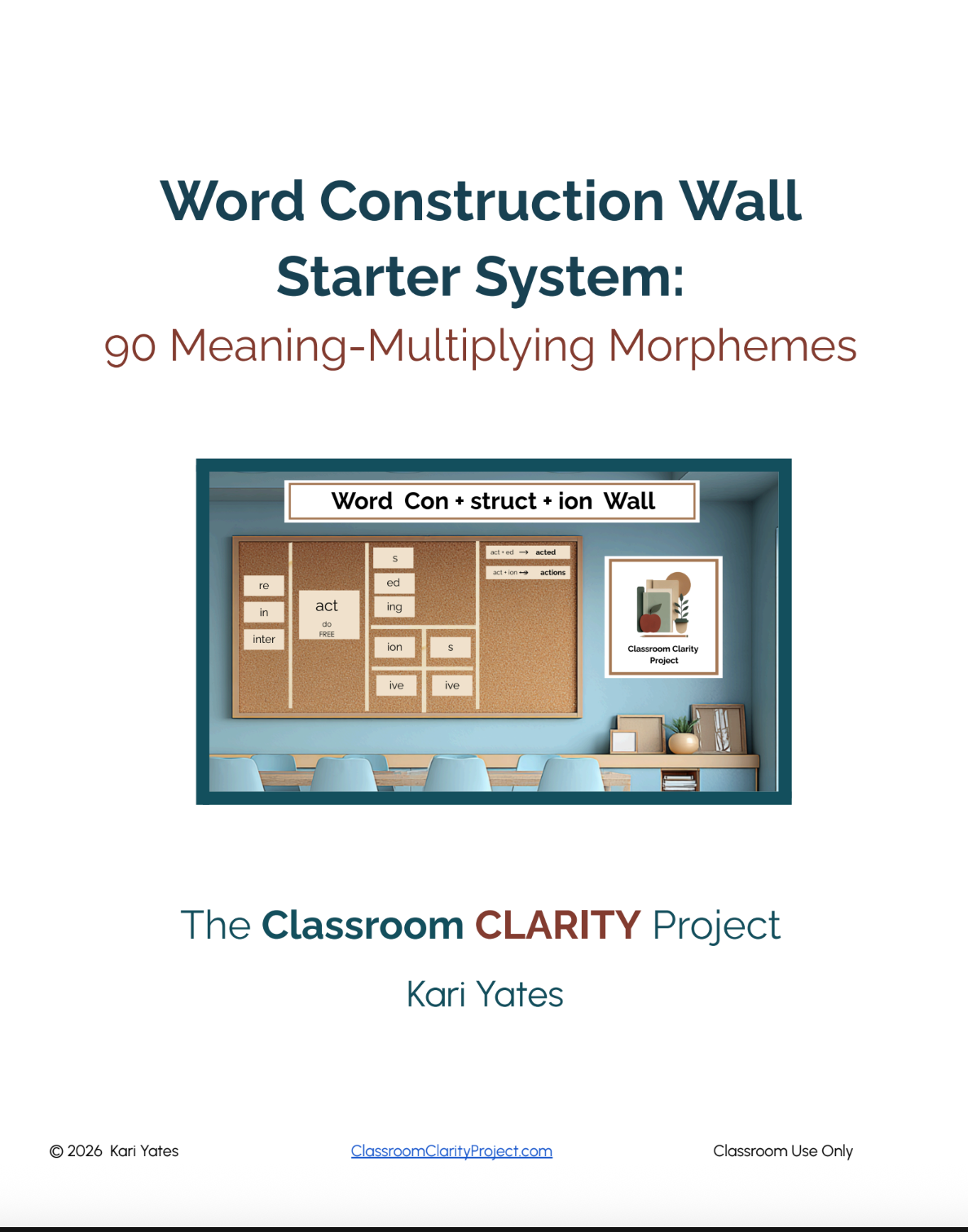
Word Construction Wall Starter Pack
A classroom tool designed to help students see how words are built across subjects. 90 Meaning-Multiplying Morphemes included.
Get the Starter Pack