


Implementation Roadmap
The Setup
Clear the visual field. Create a simple grid with masking tape. Keep your design high-contrast and free of decorative clutter.
Co-Construction
Start with one base. Build one word sum at a time with students. Pause, define, and interpret before adding more.
The Archive
Use personal Morphology Fieldbooks to store the “expanding universe” of words, keeping the wall focused only on what is in use.
Transfer
Remove finished sets to maintain clarity. Encourage students to independently test new combinations.
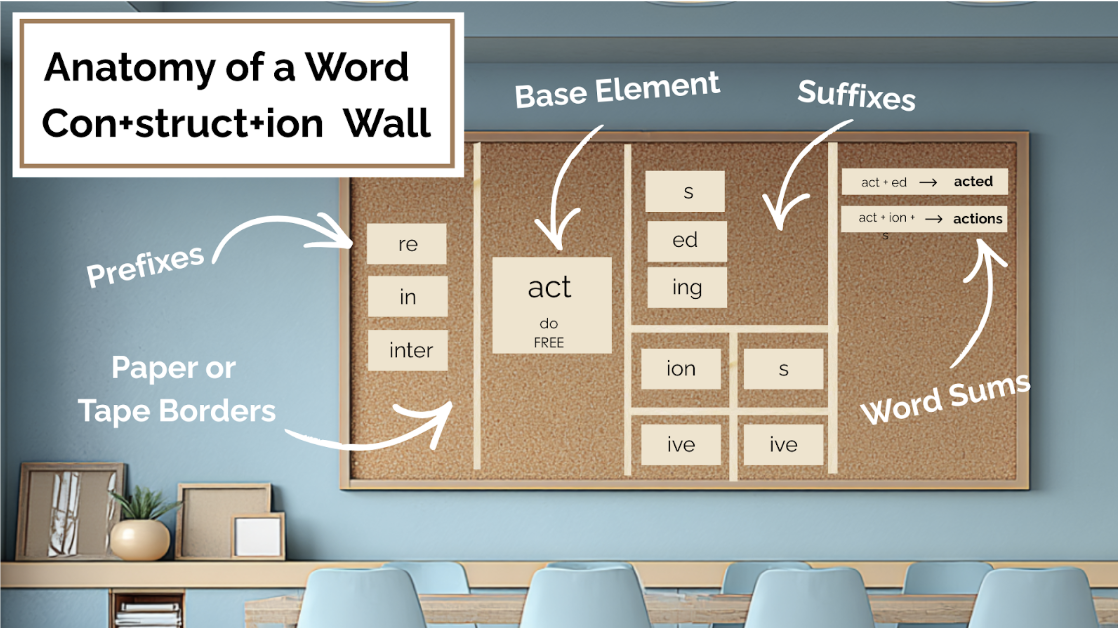
There is so much talk about morphology right now.
Workshops. Social media threads. Printable packs. An entire bulletin board devoted to known prefixes and suffixes.
The renewed attention to word structure is long overdue and exciting for sure.
But many teachers are still wondering something very practical:
How do I make a Morphology Word Wall actually work in my classroom?
Not just exist.
Not just decorate.
Not just become something students stop seeing by mid-October.
This post is an invitation to think differently about what a morphology word wall is for.
Why Most Morphology Word Walls Miss the Mark
If you search “Morphology Word Wall,” you’ll mostly find pre-made sets of affixes and bases printed in bright colors and posted all at once. The intention is good. The visual impact is immediate.
But here’s the quiet problem: when dozens and dozens of morphemes go up at the same time, the wall becomes informational overload.
We have seen this pattern before. High-frequency word walls with 200 words. Vocabulary walls that never change. Anchor charts layered on top of anchor charts. When every inch of space is filled, students learn to tune it out. It becomes just more visual background noise rather than a thinking tool.
Cognitive load matters. Our students’ attention is limited. If the wall is saturated with information that is not immediately in use, it stops supporting learning and starts competing with it. A Morphology Word Wall should reduce cognitive load, not increase it.
A Shift in Framing: From Display to Construction
Instead of treating morphology as a collection of labels to post, what if we treated it as a system to build?
Morphology is generative. A small number of meaningful elements combine to create hundreds of words. That generative power is the point. So the wall should reflect that.
I call this approach a Word Construction Wall. The word “morphology” still matters, but the focus shifts to what students are actually doing: constructing words and meaning. Visually, it resembles a morpheme matrix. But instead of being printed and laminated, it grows slowly with students over a short period and is then refreshed with a new set of morphemes. New word construction possibilities!
The wall is not a catalog.
It is a workspace.
What a Word Construction Wall Looks Like
The design of a Word Construction Wall is intentionally simple. Masking tape or straight bulletin board border strips form a clean grid. Off-white index cards or sentence strips hold the morphemes. Clean black font, easily legible from a distance.
No color coding.
No decorative clutter.
The calm design is not an aesthetic preference. It is instructional.
When the visual field is quiet, structure stands out. Students can see how elements relate. The organization communicates that this is a system with predictable parts. The wall is divided into intentional columns: prefixes, a base element, and suffixes.
Sometimes one column of prefixes and one of suffixes is enough. Other times — especially with more complex constructions — you may need to adjust your borders to accommodate additional columns. The structure should reflect the words you are building, not be a preset template.
Be sure to leave space for word sums with simple meanings. That final column is essential. Words are not just combined; they are interpreted. Writing the word sum and stating the meaning connects structure to sense, which is where real understanding begins.
Start Small. Very Small.
The wall begins with a single base.
Choose one that matters in your current instruction, ideally from a content-area text your students are reading. A base like act, form, cycle, struct, or port has tremendous generative potential, but the key is relevance.
Post the base. Include its core meaning. Clearly label whether it is a FREE or BOUND base.
And then pause.
Let students take that in.
Next, add inflectional endings. -s, -ed, -ing is how they work with the base element. Build one word together. Write the word sum with students and post it in the final column.
Meaning: did something
This is not pre-printed. It is co-constructed. Students watch the structure unfold in real time. Later, introduce a single prefix. Build another word. Discuss how the meaning shifts. Write the word sum together and post it.
The wall grows across days, not minutes.
Each addition expands possibility. Each addition increases generative power.
Why This Approach Works
First, it protects cognitive space. Only a handful of morphemes are visible at one time. Everything on the wall is there for a reason and actively in use.
Second, it highlights relationships. Students see that a base remains stable while prefixes and suffixes shift meaning in predictable ways. They experience morphology as a system rather than a list to memorize.
Third, it connects directly to real reading and writing. The base comes from meaningful text. The derived words show up in academic vocabulary. The wall becomes a tool students can actually use when they encounter unfamiliar words.
Over time, students begin to test combinations independently. They ask, “Could we add this?” They start noticing familiar bases across subjects. That is when the wall has moved beyond display and into transfer.
Where the Larger Morpheme Collection Lives
You may be wondering: what about all the other prefixes and suffixes?
Instead of crowding the wall with every option, students maintain Morphology Fieldbooks. In their fieldbooks, they record new bases, meanings, word sums, and notes about whether a base is FREE or BOUND. The fieldbook becomes the growing archive.
The wall stays focused.
The notebook holds the expanding universe.
This separation keeps the classroom environment clean while still honoring the system’s breadth.
Making Sure It Doesn’t Become Noise
The difference between a helpful Morphology Word Wall and visual clutter is intentional restraint.
Post only what you are actively using. Remove or archive elements once the study of a set of word relatives is complete. Keep the design high contrast and simple. Resist the urge to fill empty space.
The goal is not exposure to as many morphemes as possible. The goal is to teach students to look inside words in order to develop a deep understanding of how a small number of morphemes combine to create meaning. When students can clearly see the architecture, they begin to internalize it.
Free Downloads to Help You Start
To support this approach, I’ve created a set of minimal, classroom-ready materials. Use them gradually. Build slowly. Let the wall reflect the learning happening in your room.
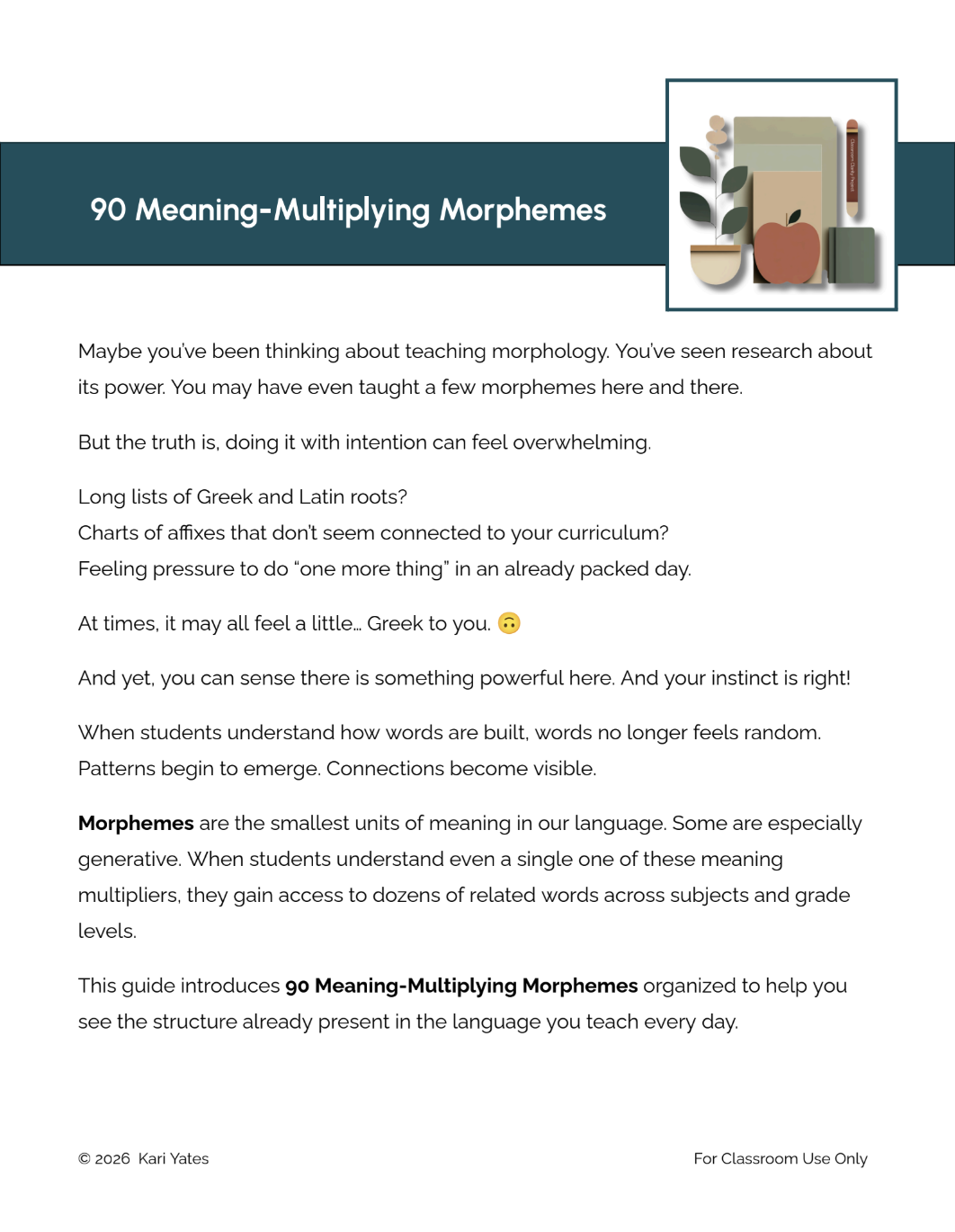
Starter Set: 90 Morphemes
30 Suffixes, 30 Prefixes, 30 Bases in simple black font.
Download Starter Set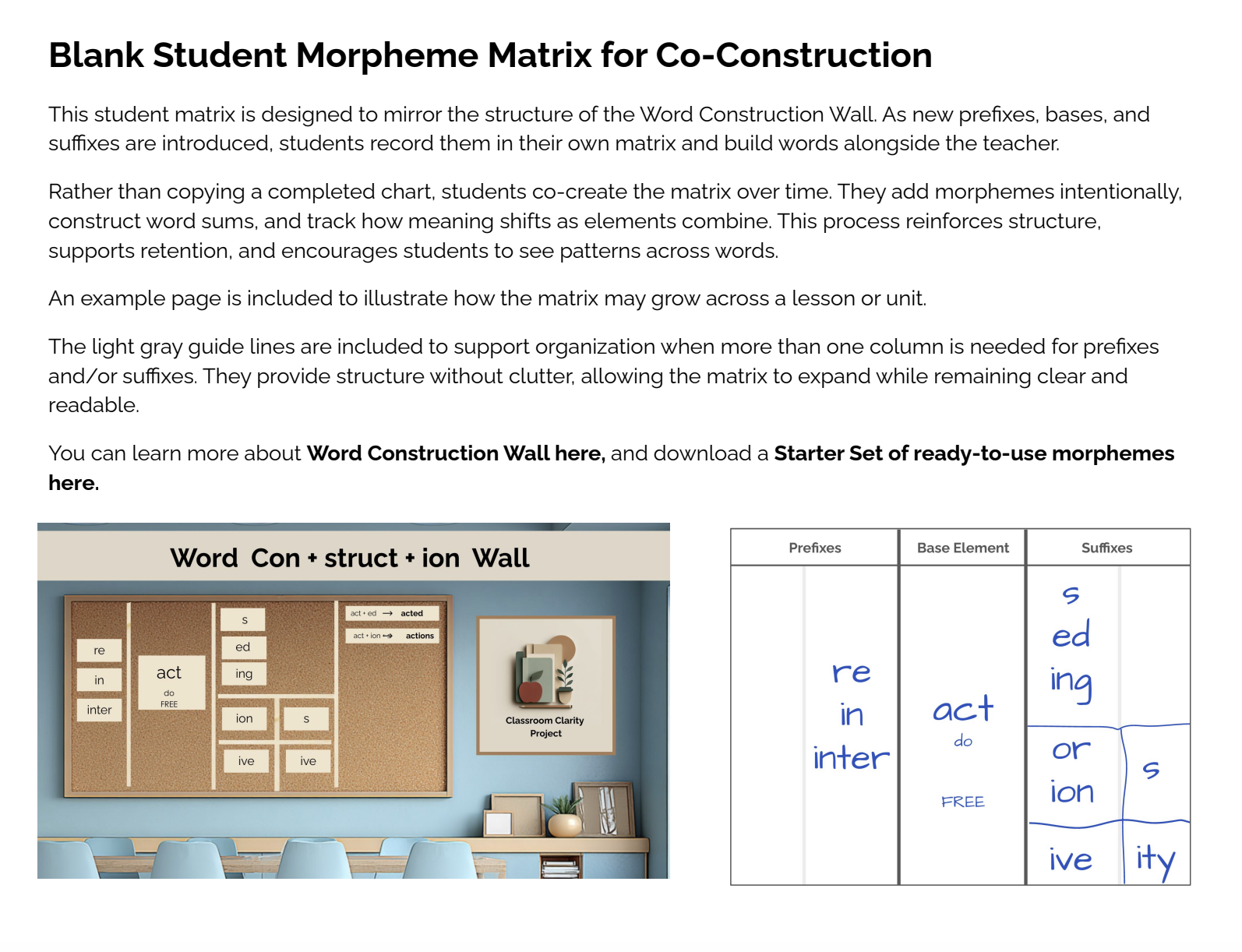
Blank Student Matrix Template
A clean template for co-construction and independent use.
Download Template